Numbers stay
about twenty seconds.
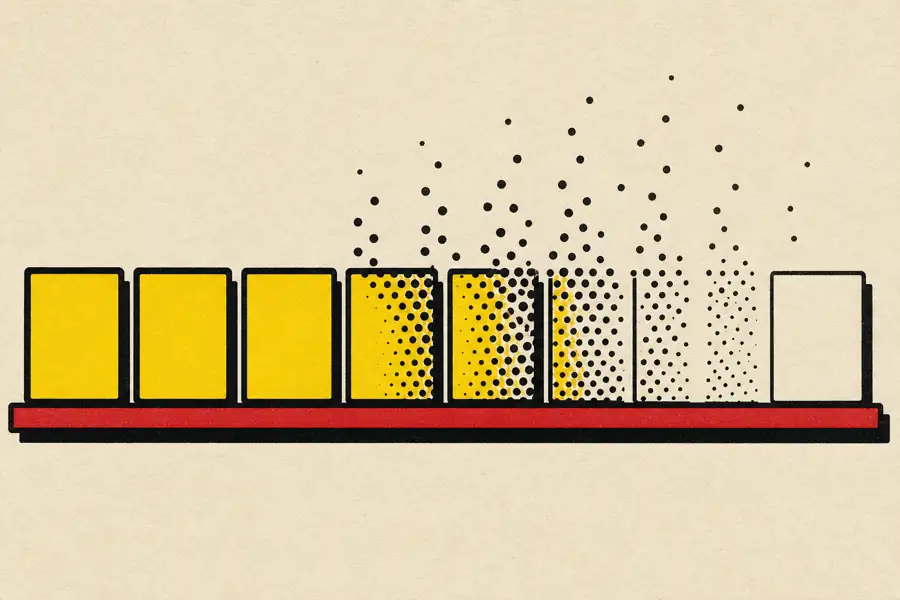
Digits appear one at a time, then disappear. Type them back in order. Each round is one digit longer — miss twice at the same length and it stops there. That is your span.
Your run
Finish a run and this fills in with what your own rounds say — nothing here is written before you play.
Where the string broke
The run above scores each sequence as one thing, right or wrong. But a missed sequence is almost never all wrong — and the page kept both what played and what you sent back, so the misses can be set down one on top of the other. The upper row is what the screen showed. The lower row is what you typed: filled where it matched, red where it did not, dashed where you ran out of digits.
- Only the misses get split into thirds. A sequence you repeated correctly is right at every position by definition. Folding those in would drag all three bars towards a hundred per cent and flatten the shape, whatever your losses actually did.
- And only the ones you answered at full length. Drop a digit in the middle and everything after it slides one place left, so comparing position to position would score the whole tail wrong and point at the end of the list when the damage was in the middle. Those rounds are drawn above and left out of the count.
- Thirds, not positions. Your sequences are different lengths, so position four means something different in a five-digit string than in a twelve-digit one. Splitting each string into a front, a middle and an end is the coarsest cut that still answers the question.
Where the number comes from
A digit span is the longest string of digits you can repeat back immediately after seeing it. The task is about as old as psychology — it was in Binet’s tests before 1910 — and it survives because almost everyone lands between five and nine.
It measures a short-lived holding area. Without rehearsal, items fade in fifteen to thirty seconds — Peterson and Peterson showed that in 1959 by filling the gap with counting backwards, which wiped the list. You hold a phone number to the keypad by re-saying it, not because the store lasts.
The clock that ran while you watched
Fifteen to thirty seconds is the figure the paragraph above quotes, and this page has a clock of its own that eats into it. Each digit is lit for 850 milliseconds and the screen sits dark for 220 after it, so a digit costs 1.07 seconds of your evening no matter what length you are on. Nothing about that is neutral: the long strings are not only longer to hold, they are held for longer before anyone lets you answer.
| Digits | Plays for | First digit’s age |
|---|
Two things this does not mean. The fifteen seconds is a figure for items nobody is rehearsing, and nobody watching a row of digits sits there not rehearsing — that is the whole reason the section below about the length of number words matters. And a slower pace would not be a fairer test, it would be a different one: more dark time per digit is more rehearsal time per digit, which lifts the printed span. A digit span is only comparable against the same clock, and almost nobody publishing one tells you what theirs was.
Seven plus or minus two is not about digits
That phrase comes from George Miller’s 1956 paper, which opens with him complaining that an integer has been persecuting him. It is the most quoted number in psychology and it is almost always quoted for the wrong claim.
- It was about chunks, not items. Miller’s point was that the limit sits on meaningful units, and that the units are yours to build. 1 4 9 2 is four items to one person and one item to another. Recoding into bigger chunks is how span gets beaten, and Miller said so explicitly.
- It was never a hard ceiling. Later work tightened it rather than confirming it. Nelson Cowan’s 2001 review put pure capacity nearer four chunks once rehearsal and grouping are blocked. The extra three or four digits most people manage are not capacity; they are technique.
- Digit span is the easy case. Digits are ten familiar symbols with short names, which is the friendliest material there is. Span for unrelated words is shorter, and for unfamiliar syllables shorter still. A number from the easiest possible material is a poor description of a limit.
Your language changes the score
This is the finding that should make anyone cautious about comparing spans between people. How many digits you can hold depends heavily on how long the digits take to say — even silently. Rehearsal runs at roughly the speed of speech, so a language with shorter digit names fits more of them into the same loop before the front of the list fades.
- The effect was found inside one head, not between countries. Ellis and Hennelly, in 1980, tested Welsh–English bilinguals in both of their languages. The same people scored lower in Welsh, whose digit names take longer to pronounce. Nothing about the person changed between the two tests.
- Short digit names run high. Mandarin digit names are short, monosyllabic and quick, and measured spans in Chinese run well above the English figure — around nine or ten rather than seven. English sits in the middle. The gap tracks pronunciation time, not anything about the speakers.
- So cross-language span numbers do not compare. A span of seven in English and a span of nine in Mandarin can describe the same capacity. Any ranking that puts them in one line is measuring syllables and calling it memory.
The test on this page shows digits rather than reading them aloud, which moves the effect but does not remove it — most people say written digits to themselves as they read. If you speak more than one language, it is worth running it twice and switching which one you count in. The difference is usually visible without any statistics.
What your span is the edge of
The staircase has a rule most people never see stated: each length gives you two shots, and either one carries you up. That sounds generous, and it is — generous in a specific, measurable direction. It means the number printed at the top of this page is not the length you can reliably do. It is close to the length you have started failing.
| One try | Moving up |
|---|
What that did to your own run
| Length | Tries | What happened |
|---|
This is also why a span moves around. The staircase stops the first time two coin-flips both come up against you, and at the lengths where you are hovering near a half those two flips decide the printed number on their own. Run it again in five minutes and the digit that changes is usually not you changing — it is the same rule landing differently.
Four things that move your result tonight
- Grouping. Reading 4 9 2 7 1 6 as two three-digit numbers is the single biggest win available, and it is why phone numbers are printed in blocks. It is a real skill, not cheating — but it means the score is partly about strategy.
- Saying them out loud. Speaking the digits as they appear reliably helps, because it commits them to the loop instead of leaving them as fading images.
- Interruption. Any thought between the last digit and your first keystroke costs you the front of the list. This is the same mechanism as the 1959 counting-backwards result, at a smaller scale.
- Tiredness and noise. Span drops when you are tired or being talked at, and the drop is large enough to swamp any difference between two people on a good day.
So the honest reading of a span is narrow: on this screen, in this language, right now, this many. It is not an intelligence score, it is not a clinical result, and a single run of it is not stable enough to compare against a friend’s single run. What it is good for is watching your own number move when you change one thing — grouping, language, time of day — which is the one comparison where everything else is held still.