Eight squares are
filled in. Work out
the ninth.
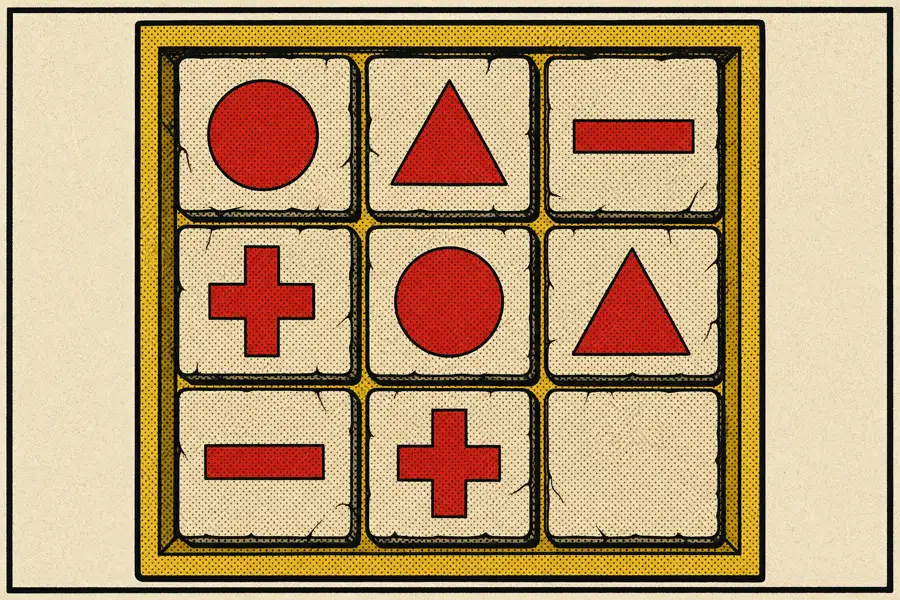
Something changes as you read each row left to right. Work out what it is, then pick the piece that belongs in the empty corner.
1 rule running in this one
Which one finishes it?
One rule at a time to start with, three at once by the end. Nothing is timed, and you cannot go back. Answers come at the end — all twenty, each with its rule spelled out.
Where it got hard
The set gets harder in one specific way: more rules running at the same time. Splitting the score along that line says more than one percentage does.
| Rules at once | Asked | Right | Rate |
|---|
Which rules caught you
Five things can change from square to square. A question with three rules in it is counted once under each of them, so these add up to more than twenty.
| What was changing | Asked | Right | Rate |
|---|
What you actually misread
Every wrong option here is the right square with exactly one thing changed: the shape, or the count, the fill, the angle, the size. So each miss names the single detail that slipped — and whether any rule in that question was even watching it.
—
—
What the third rule costs
Rules do not add up, they pile up: you have to keep holding the first one while you work out the second. The clock is where that shows — the gap from one rule to two, and then from two to three.
—
—
Which two, together
Five things can change, so there are ten ways two of them can run at once. Twenty questions cannot cover ten pairs evenly, and the draw is random. This is which pairs your set actually put in front of you, and which it skipped.
—
—
All twenty, replayed
Each grid is redrawn with the ninth square filled in, and the rule that was running through it written out underneath. The ones you missed also show what you picked, next to what was right.
How these are built
- The questions are generated, not stored. Reload this page and you get twenty different grids. There is no bank of items to memorise and no way to have seen these exact ones before, which also means nobody can hand you an answer key.
- The rule always runs across the row. Either the same thing steps through three values in every row, or each row shifts it along by one so that every value shows up once per row and once per column. Both are readable from left to right. Nothing depends on adding shapes together or counting sides.
- Five things can change: how many shapes there are, whether they are empty, half-toned or solid, which way they point, which shape they are, and how big they are drawn. Anything a rule is not controlling is held identical in all nine squares, so there is exactly one defensible answer.
- The five wrong options each change one thing about the right answer — not always the thing the rule was about, because if the distractors only varied along the rule you could throw three of them out without reading the grid at all.
- No two options ever look the same. They are compared as pictures rather than as descriptions, which matters more than it sounds: a diamond turned 90° is the same drawing as a diamond turned 0°, and a square is a diamond turned 45°. Comparing the underlying numbers instead would quietly put the same shape in the list twice.
- Nothing is timed and nothing tells you if you were right until the end. Knowing the answer to question six changes how you read question seven, and a visible clock turns this into a speed test. Your time per question is recorded and reported, but it never touches the score.
- A miss names one detail, not one cause. Because every wrong option differs from the right one in exactly one way, the square you picked says precisely what you misread. It does not say why. Reading the rule correctly and then grabbing the wrong square looks identical here to never having seen the rule at all.
- The time per rule count is a median, and it is not a clean experiment. A median rather than an average, because a single interruption — a phone call, a scroll away — would drag an average over five questions anywhere it liked. Not clean, because the rule count rises as you go: the three-rule questions are also the last seven. Warming up and wearing out are mixed into that gap and cannot be separated out of twenty questions.
- Ten pairs do not fit into twenty questions. With five rules there are ten ways two of them can run together, and which ones your set draws is chance. Some pairs turn up four times, some never. The pair section is a map of what you happened to be asked, not a ranking of what you are good at — one miss out of one is not a weakness.
- This is not an IQ score and cannot be converted into one. A real one is a rank against a large sample of people your age, measured under controlled conditions across several different kinds of task. This is twenty grids on your phone, and what it actually tells you is which of the five rules you find easy to see and which one you keep walking past.